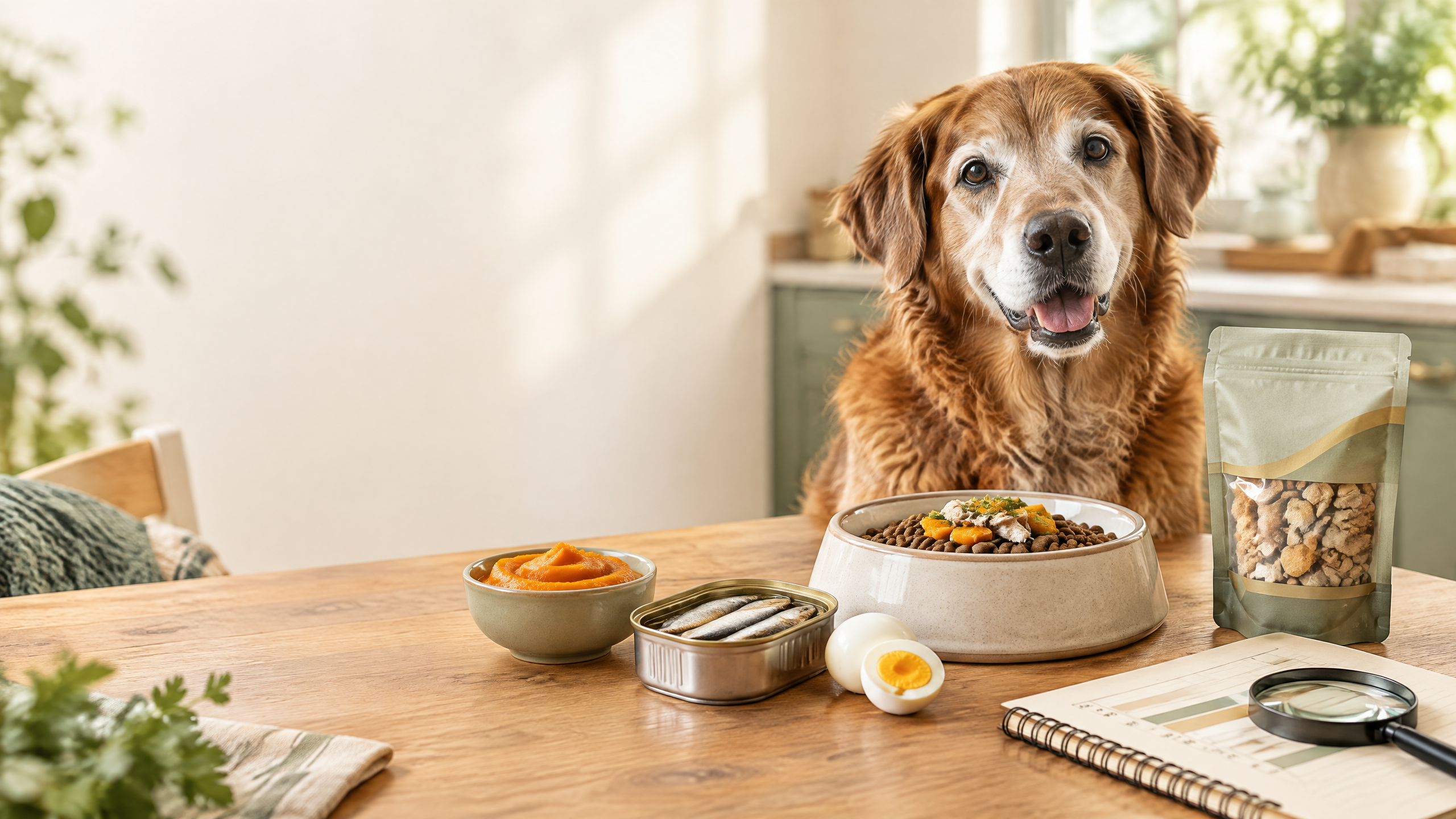
Walk down the dog food topper aisle and it's easy to feel like you need to spend real money to make your senior dog's kibble worth eating. Freeze-dried bags in fancy packaging can run $45, $50, sometimes $60. But does a pricier topper actually do more for your dog, or are you mostly paying for the bag?
Let's do the honest math.
Why Your $60 Topper Might Not Outperform a $12 One
Here's a real example: an 18-oz bag of a well-known freeze-dried raw topper typically retails around $45–50 (closer to $47 with a subscription discount). Step up to a "complete diet" style topper — the kind meant to double as a full meal — and you're often looking at $55–60 for a similarly sized bag.
That's not a knock on those products. Many are genuinely good. But price alone doesn't tell you whether a $60 topper is nutritionally doing more for your senior dog than a $12 one. What actually matters is what's on the guaranteed analysis panel — protein percentage, fat, moisture — not the price tag or the packaging.
A $12 topper built from real, simple ingredients (more on that below) can land in a similar protein range as a $47 freeze-dried bag. The expensive one is usually paying for freeze-drying equipment, branding, and shelf life — not necessarily a nutrition tier your dog can taste the difference of.
Before you assume "expensive means better," it's worth checking the actual numbers instead of guessing from the price.
Run any bag through our free tool →The $47 Topper Revolution: Beating Fancy Brands at Their Own Game
So what is that $47 bag actually doing that makes dogs go crazy for it? Mostly three things: it's protein-dense, it's aromatic, and it's moist compared to dry kibble. None of those three things require a $47 price tag.
- Protein-dense — a spoonful of shredded chicken or a scrambled egg does the same job.
- Aromatic — warm bone broth or a little sardine juice hits the same "umami" note.
- Moist — anything wet mixed into dry kibble changes the texture instantly.
You can "beat" a fancy brand at its own game by hitting those same three notes with groceries you probably already buy. The bag isn't magic — it's just a convenient, pre-portioned way to deliver protein, aroma, and moisture. You can deliver the same three things yourself for a fraction of the cost.
Honest Topper Math: What $12 a Month Actually Buys Your Senior Dog
Here's a real, buildable rotation using current grocery prices:
| Topper | Cost | How far it goes |
|---|---|---|
| Canned pumpkin (15 oz) | ~$2/can | About a month of daily 1-tbsp servings |
| Sardines in water (3.75 oz) | ~$1.10/can | 3–4 uses per can |
| Eggs | ~$3.50–4/dozen | A dozen covers ~2 weeks at one every other day |
Put together — a rotation of a daily spoonful of pumpkin, a few sardine servings a week, and an egg every other day — lands right around $11–12 a month. That's genuinely under $1 a day, and it covers three different flavor and texture profiles so your dog isn't eating the exact same topper every single day (remember kibble fatigue applies to toppers too).
A few notes to keep this safe:
- Plain canned pumpkin only — not pumpkin pie filling, which has added sugar and spices.
- Sardines packed in water, not oil or sauce, and check for no added salt.
- Eggs should be cooked, not raw, to avoid biotin and salmonella issues.
- Introduce anything new gradually, especially with a senior dog's digestion.
Nutrient Density: How Toppers Stack Against Whole Food
Here's the honest part a lot of marketing skips: ounce for ounce, whole foods are often just as nutrient-dense as processed toppers, sometimes more so. An egg delivers a solid dose of complete protein for under 40 cents. A can of sardines packs a meaningful amount of protein plus omega-3s for around a dollar. Canned pumpkin isn't a protein source, but it's a cheap, gentle source of fiber that a lot of senior dogs do well with.
Freeze-dried commercial toppers are convenient and shelf-stable, and the good ones are formulated with a specific protein percentage in mind. But "freeze-dried" and "premium" aren't nutrition claims by themselves — they're processing and marketing terms. The only way to actually compare a whole-food topper to a bagged one is to look at the numbers, not the label design.
One important caveat: none of these toppers, cheap or expensive, are meant to replace your dog's complete and balanced base food. Toppers add flavor, moisture, and a bit of extra nutrition on top of a diet that's already doing the heavy lifting. If you're not sure your dog's base food is pulling its weight, that's worth checking before you spend money on any topper at all.
Putting the Math to Work
If your senior dog has gotten picky, you don't need to start with the $47 bag. A reasonable order of operations:
- Try a $12-a-month rotation of pumpkin, sardines, and egg for a couple of weeks.
- Watch for the same signs of kibble fatigue easing up — more interest, less hesitation at the bowl.
- If it's working, there's no need to spend more. If it's not, that's useful information too, and a commercial topper (or a different base food entirely) might be the next step.
Budget joint toppers are also worth a look if your senior dog is dealing with stiffness alongside pickiness — cost-consciousness doesn't have to stop at flavor.
And if you want the full cost-per-day breakdown across every topper category, not just the budget end, see the full cost-per-day math in our companion piece.
Whichever topper you land on, it's worth seeing what's actually in the bag before you commit to it long-term.
Check your current bag (free, 30 sec) →