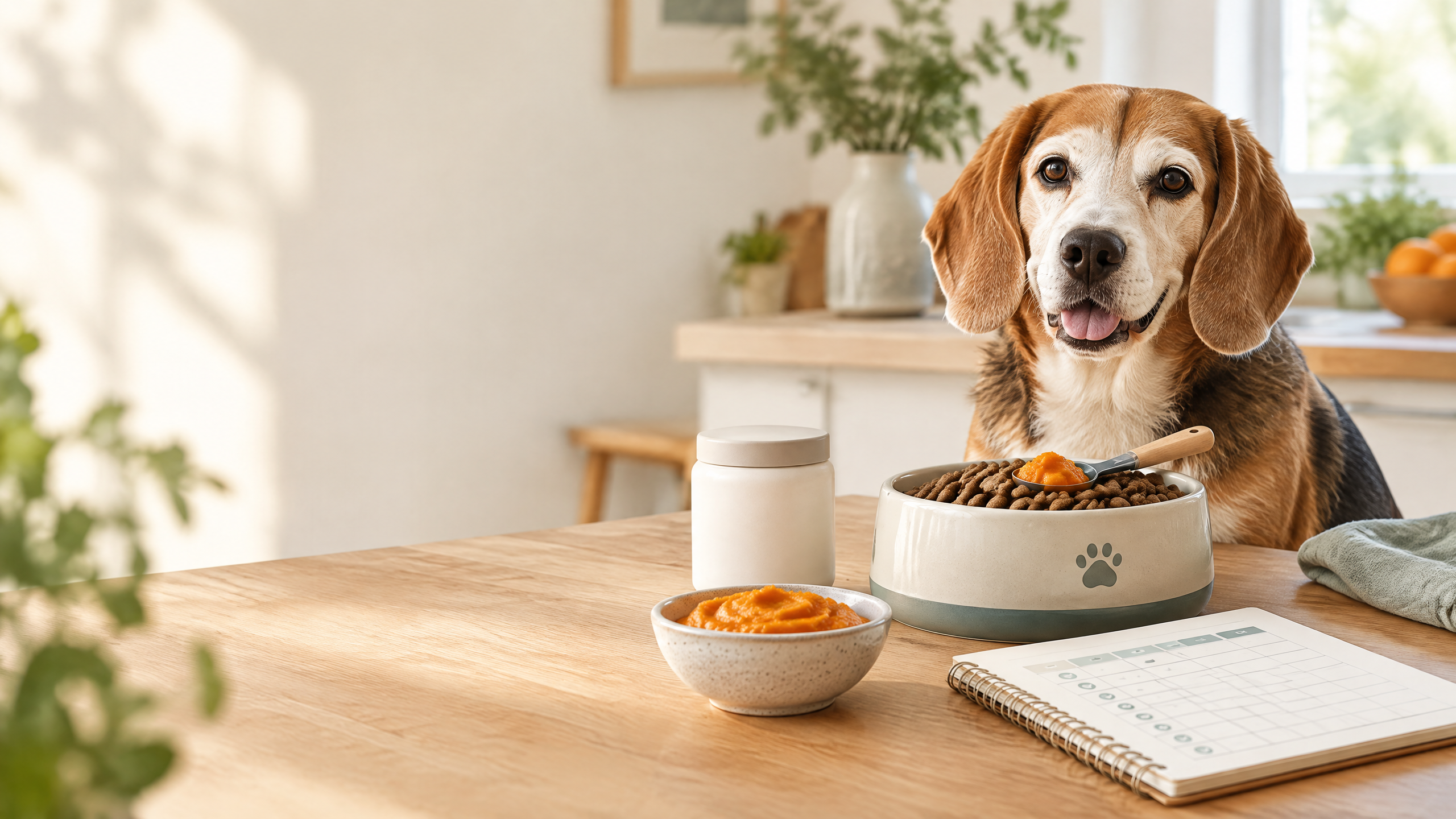
Gut health toppers are everywhere right now — probiotics, prebiotics, "digestive support" blends, all promising a happier stomach and better stools. Some of that is genuinely useful. Some of it is marketing language stretched further than the research actually goes. Here's an honest look at what gut-health toppers are trying to do, what's reasonably well-supported, and what's still up for debate.
Gut Health Markers: How to Spot If a Topper Is Actually Working
Unlike joint stiffness, which can be subtle, gut health has some pretty visible markers you can actually track. If you're trying a digestive topper, here's what's worth watching over a couple of weeks:
- Stool consistency — firm and well-formed is the goal; consistently soft, greasy, or watery stool is worth noting
- Frequency — a sudden increase or decrease from your dog's normal pattern
- Gas — more (or less) than usual
- Appetite and energy — a gut that's working well often shows up as steadier energy, not just better stools
- Coat condition — not a direct gut marker, but chronic digestive issues can sometimes show up here too
A simple way to actually know if a topper is helping: keep a two-week log. Nothing fancy — just a quick daily note on stool quality (a 1–5 scale works fine) and anything unusual. Change one thing at a time, the same way you would with any other topper, so you know what's actually responsible for any improvement.
Probiotic Toppers and Gut Inflammation: What the Research Suggests
Probiotics — live beneficial bacteria — are the most common ingredient in gut-health toppers, and there's a reasonable amount of research behind the general idea that a healthy gut microbiome plays a role in digestion, immune function, and inflammation. Strains like Enterococcus faecium and Bacillus coagulans show up often in veterinary-formulated probiotics because they're relatively stable and well-studied compared to some others on the market.
Where things get murkier is in the specifics: which exact strain, at what dose, for which dog, and for how long. Research in this space is still developing, and a lot of what's marketed as "clinically proven" on a topper label is extrapolated from limited studies rather than settled science. That doesn't mean probiotics are useless — it means the confident, specific claims on some packaging are often ahead of what the research actually shows.
One practical wrinkle: probiotics have to survive digestion to do anything useful, and not every product delivers live, viable bacteria all the way to the gut. Probiotic absorption science is really its own topic — worth understanding before you assume "contains probiotics" on a label means much on its own.
There's also a connection worth knowing about: chronic gut inflammation doesn't always stay contained to digestion. Gut inflammation and joint pain are linked more often than people expect, since inflammatory signals from the gut can influence how the rest of the body responds to everyday wear and tear — including aging joints.
What May Help — and What's Still Debated
It's worth separating the gut-health topper category into two honest buckets.
Reasonably well-supported
- Fiber (like plain canned pumpkin or psyllium) for regulating stool consistency, in both directions
- Digestive enzymes for dogs with a diagnosed enzyme insufficiency (this is a real, vet-diagnosed condition, not a guess)
- Bland, low-fat diets temporarily during an active digestive upset, on a vet's recommendation
Still debated or unproven for most dogs
- Specific probiotic strain claims tied to particular health outcomes
- "Leaky gut" and similar marketing terms borrowed loosely from human wellness trends
- Superfood add-ins (turmeric, various "gut-healing" powders) with more buzz than dog-specific research behind them
None of this means the debated category is worthless — plenty of owners try these and are happy with the results. It just means "may help, evidence still developing" is the honest label, not "clinically proven."
Since gut-health topper labels tend to lean hardest into unverified language, it's worth checking before trusting the front-of-bag claims — things like vague "proprietary blend" listings or probiotic counts that aren't actually guaranteed anywhere on the label.
Check your topper for hidden issues →Why Some Senior Dogs Eat Poop (And Whether Toppers Actually Help)
This one comes up more than owners like to admit, and it's a legitimate gut-health question, not just an odd habit. Coprophagia (eating stool) in senior dogs can have a few different roots:
- Nutrient or enzyme gaps — a long-standing theory, though not proven for most cases
- Behavioral or stress-related habits, sometimes carried over from puppyhood or triggered by anxiety
- Underlying medical issues — parasites, pancreatic insufficiency, or malabsorption conditions can all be real contributors and need a vet to actually diagnose
Some owners try digestive enzyme or probiotic toppers hoping to address a nutrient-gap theory, and anecdotally, some see improvement. But because the underlying cause varies so much dog to dog, there's no topper that reliably fixes this across the board.
Should You Add a Gut Health Topper?
If your senior dog has normal, healthy digestion already, a gut-health topper isn't solving a problem that exists — it's a "may help a little, low risk" addition at best. If your dog has ongoing soft stools, irregular digestion, or gas that's more than occasional, a fiber source or a well-formulated probiotic is a reasonable, low-cost thing to try, tracked over a couple of weeks with the markers above.
Before you buy anything specifically marketed for gut health, it's worth seeing what's actually guaranteed on the label versus what's implied by the packaging.
Check your current bag (free, 30 sec) →The Bottom Line
Gut health is a real, meaningful part of a senior dog's overall wellbeing, but it's also one of the most overhyped topper categories out there. Fiber and diagnosed enzyme support have solid ground under them. Probiotics are promising but still an evolving science, especially at the specific-strain level. And persistent digestive symptoms, including coprophagia, deserve a vet visit before a topper, not instead of one.
This post is for general information and isn't a substitute for veterinary advice. Ongoing digestive symptoms, sudden changes in stool or appetite, or new behaviors like stool-eating are worth discussing with your vet to rule out an underlying medical cause.