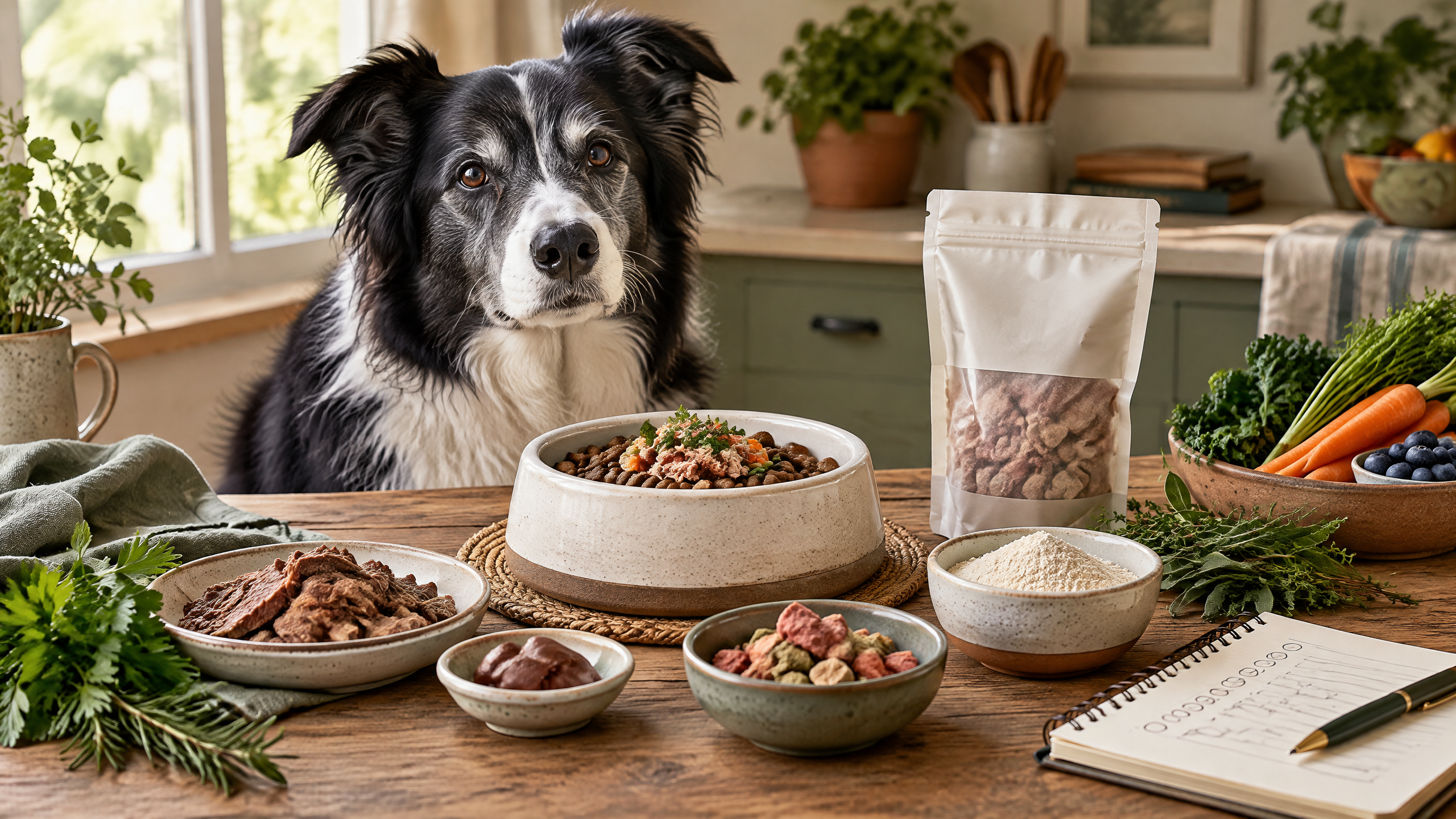
Raw and BARF (Biologically Appropriate Raw Food) toppers have a devoted following, and a lot of the appeal comes down to one idea: dogs descended from wolves, so feeding them something closer to what a wolf would eat feels intuitively right. That idea is worth examining honestly — what it gets right, what it oversimplifies, and what actually matters if you're considering it for a senior dog.
Ancestral Feeding: What Wolves Ate, and Why the Story Is More Complicated
Wild wolves eat whole prey — meat, organs, bone, stomach contents, all of it. The ancestral diet argument says modern dog food strayed too far from that, and that toppers modeled on ancestral eating (raw meat, organ, bone) are "rediscovering" what dogs are actually built to eat. There's something to this: dogs are physiologically closer to wolves than to, say, cats when it comes to digestive anatomy.
But the ancestral argument gets one big thing wrong if taken too literally: dogs aren't wolves anymore, genetically speaking. One of the clearest documented differences is the AMY2B gene, which controls starch-digesting enzyme production — domestic dogs typically carry many more copies of it than wolves do, a genetic adaptation from thousands of years living alongside humans and eating scraps, including starchy ones. In plain terms: dogs evolved, in real, measurable ways, to handle a broader diet than a wolf's. "Eat like a wolf" is a useful mental model, not a precise nutritional blueprint.
What ancient feeding practices actually got right — and what modern raw and freeze-dried topper brands are genuinely rediscovering — isn't "feed exactly like a wolf." It's simpler: minimally processed, recognizable ingredients tend to retain more of their original nutritional value than heavily processed ones. That's a real, defensible point, even without the wolf framing doing the heavy lifting.
BARF Diet Decoded: What the Microbiome Research Actually Shows
BARF diets emphasize raw meat, bone, and organ in specific ratios, with the claim that this better supports a dog's natural gut microbiome. There is real research comparing the gut microbiomes of raw-fed and kibble-fed dogs, and some studies do find measurable differences in bacterial populations between the two groups.
Where the research is more cautious than the marketing is on what those differences actually mean for health outcomes. A different microbiome composition isn't automatically a "better" one — the science connecting specific microbiome shifts to specific health benefits in dogs is still developing, similar to where human microbiome research stood a decade ago. It's a genuinely interesting and active area of study, not yet a settled case for raw feeding being categorically superior.
Whole Prey Feeding Myths: What a Topper Actually Needs to Replicate
A true whole-prey diet aims for a rough ratio of muscle meat, bone, and organ (often cited around 80/10/10). A common myth is that a topper needs to literally mimic a whole animal to provide any benefit. It doesn't — and for most senior dogs, it shouldn't, since whole prey feeding (especially with bone) carries real handling and safety considerations.
What a topper can realistically replicate is the ratio's intent, not the literal form: a little organ meat (nutrient-dense), a little bone content (usually as ground bone or bone meal, not whole bones for a senior dog), and quality muscle meat. You don't need actual prey animals to capture what the ratio is trying to achieve.
Raw-Fed Dogs and Coat Quality: What Owners Consistently Report
This is one of the most commonly repeated observations from raw-feeding owners: shinier, softer coats after switching. It's worth being honest about what this is and isn't. It's a consistent anecdotal pattern, not a controlled clinical finding. Coat quality is genuinely influenced by fat content and fatty acid profile, and raw diets are often higher in fat than the kibble they replaced — so an improved coat may reflect a fat and omega increase more than "rawness" itself. A well-formulated non-raw topper with similar fat and omega-3 content could plausibly produce a similar result.
Health Markers Raw-Feeding Owners Track
Owners who raw-feed tend to track a consistent set of markers, and they're genuinely useful ones regardless of what diet you choose:
- Stool volume and consistency — raw diets are typically more digestible with less waste, though this varies by ingredient quality on any diet
- Coat and skin condition
- Energy level and body condition
- Dental cleanliness, particularly with raw bone chewing (with real caveats below)
These are reasonable things to track on any topper trial, raw or not — the tracking habit is the useful part, independent of which diet philosophy you follow.
Safety Considerations for Senior Dogs Specifically
Raw feeding carries real risks that deserve a straightforward mention, not a footnote. Raw meat can carry Salmonella, Listeria, and other pathogens — a risk to your dog and to anyone in the household handling the food, including immunocompromised family members. Whole or large raw bones also carry a real risk of tooth fracture, which is a bigger concern in senior dogs who may already have dental disease or more brittle teeth.
If raw feeding appeals to you, lower-risk entry points include commercially prepared raw or freeze-dried products that have gone through a pathogen-reduction step (like high-pressure processing), rather than feeding raw meat straight from the grocery store, and avoiding whole recreational bones for a senior dog in favor of ground bone content instead.
BARF for Beginners: A Senior Dog Transition Guide
If you want to try a BARF-style topper with your senior dog, a cautious, gradual approach works best:
- Start with a small amount mixed into their current food, rather than a full switch.
- Introduce one new protein at a time, watching for digestive upset over several days before adding another.
- Keep the ratio simple at first — mostly muscle meat with a small amount of organ, holding off on bone content until you're confident in how your dog tolerates the rest.
- Work with your vet, or ideally a board-certified veterinary nutritionist, if you're moving toward BARF as a larger part of the diet rather than a light topper — homemade raw diets are frequently found to be nutritionally incomplete without careful formulation.
- Track the health markers above over a few weeks rather than judging on day one.
The Bottom Line
The ancestral diet argument gets something right: minimally processed, high-quality ingredients are generally a good thing. It overreaches when it implies dogs need to eat like wolves to thrive, given how much dogs have genetically diverged from their wild ancestors. Raw and BARF toppers can be a reasonable choice for some senior dogs, introduced carefully and with real safety precautions in mind — but they're not a magic upgrade path, and a well-chosen non-raw topper can deliver a lot of the same practical benefits (protein, moisture, aroma) without the handling risks. Ollie (affiliate link) is one example of that fresh-but-not-raw middle ground.
If picky eating is part of what's driving your interest in raw, it's worth knowing why raw often works for picky dogs — the aroma and moisture that make raw appealing to fussy eaters can often be replicated with lower-risk options first. And because raw food behaves differently in digestion than kibble, why raw absorbs differently than kibble is worth understanding before assuming "raw" automatically means "more absorbable."
See how your dog's current base food compares, whatever direction you decide to take the topper conversation.
Check your current bag (free, 30 sec) →