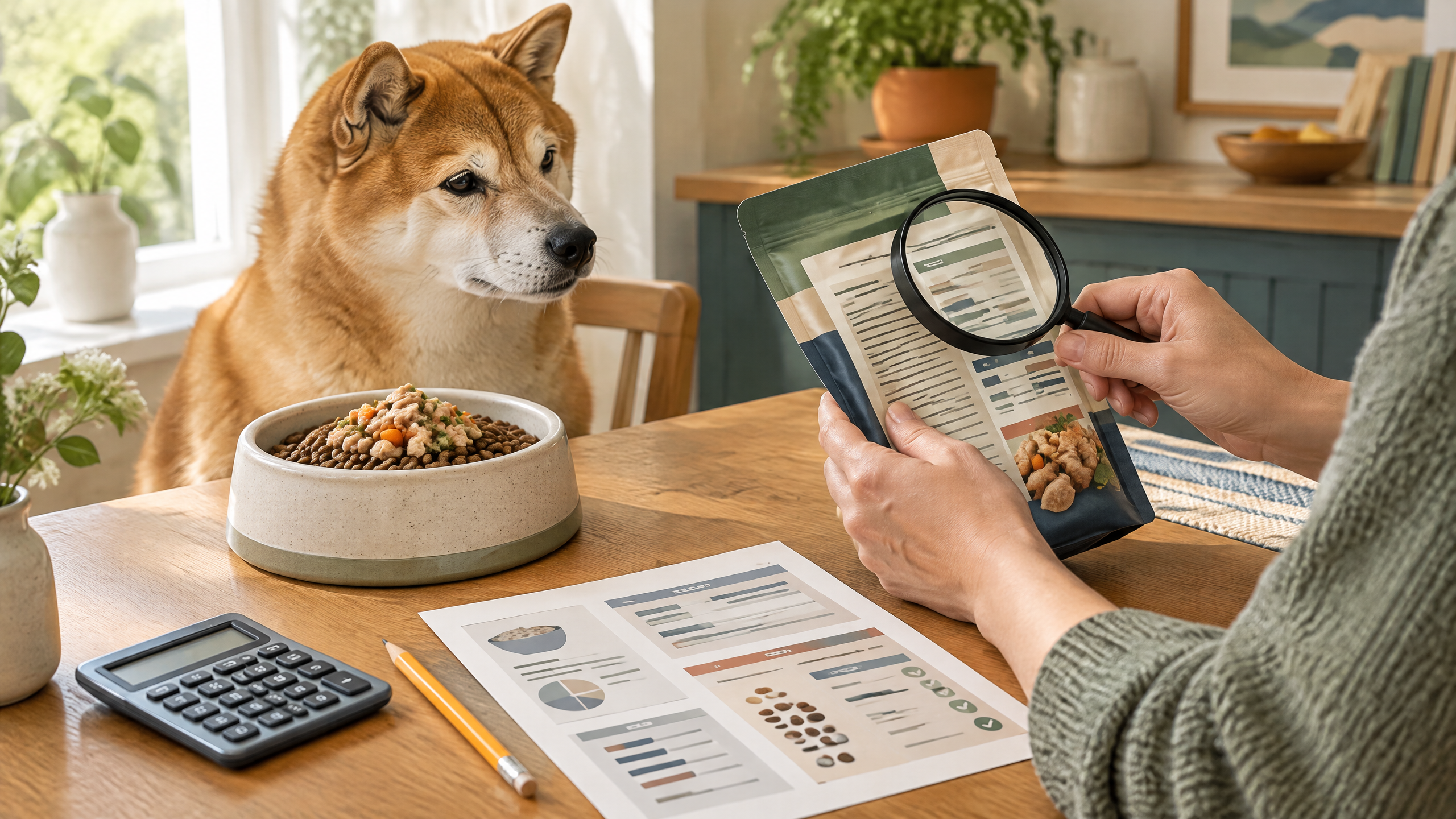
There's a growing group of dog owners who've stopped taking pet food packaging at face value — call it kibble snob culture if you want, but "wanting to actually know what's in the bag" isn't snobbery, it's just paying attention. The good news is you don't need a nutrition degree to read a label well. You need to know what a handful of terms actually mean, and where brands tend to get vague on purpose.
The Hidden Carbohydrate Issue
Here's something most labels never state directly: dog food and toppers don't have to list carbohydrate percentage anywhere. AAFCO's guaranteed analysis requires protein, fat, fiber, and moisture — carbs are just whatever's left over, and most brands don't volunteer that number because it's often higher than the marketing implies.
You can estimate it yourself with simple subtraction:
100% − (crude protein % + crude fat % + crude fiber % + moisture %) ≈ estimated carbohydrate %
This isn't a lab-perfect number (it lumps in ash and a few other odds and ends), but it's a genuinely useful gut check. A topper marketed heavily around its protein content can still have a surprising amount of carbohydrate filling out the rest of the formula, especially in dry, starch-bound products.
The Topper Transparency Report: Terms That Mean Something vs. Terms That Don't
Some words on packaging are legally defined and mean something specific. Others are essentially decoration. Knowing the difference is most of what "reading a label like a pro" actually is.
✓ TERMS WITH REAL LEGAL MEANING
- Human-grade — every ingredient and the facility must meet human food standards. Ollie (affiliate link) is one brand that actually meets this bar.
- Chicken meal (or any named-species meal) — a defined, regulated ingredient
- Complete and balanced — meets AAFCO nutrient profiles for a life stage
✕ TERMS WITH LITTLE OR NO DEFINITION
- Natural — loosely regulated, guarantees little
- Holistic, premium, super-premium — no legal definition at all
- Gently cooked, flash frozen — descriptive, no actual standard
None of the undefined terms are automatically dishonest. But they're not evidence of anything either, and a label leaning heavily on them instead of specifics is worth a second look.
Nutrient Absorption Gaps: What the Label Can Hint At
You can't measure bioavailability by eye, but a few label details are genuine clues about it:
- AAFCO statement type. Look for "animal feeding tests using AAFCO procedures" versus "formulated to meet AAFCO nutrient profiles." The first means the product was actually tested by feeding it to real dogs; the second means it was calculated on paper to hit target numbers, which isn't the same as proven digestibility.
- Unnamed protein sources. "Meat meal" or "animal digest" without a named species is vaguer and more variable than "chicken meal" or "salmon meal."
- Excess ash content, if listed. Very high mineral (ash) content can interfere with absorption of other nutrients — most quality toppers keep this modest.
None of these tell you everything, but together they paint a more honest picture than the front of the bag does.
Gut Absorption and Generic Toppers: What to Watch For
Store-brand or generic toppers aren't automatically worse, but they do tend to be vaguer on the details that matter for consistency:
- Batch-to-batch variability — vague ingredient sourcing ("meat and bone meal" with no species) can mean the actual formula shifts more between batches than a named-ingredient product would.
- Lack of contact information or lot codes — a brand willing to put a real address, lot number, and customer service line on the package is signaling it stands behind quality control.
- No third-party testing or certification mentioned — not required, but its presence is a positive signal when comparing two similar products.
If your senior dog seems to react differently to different bags of what should be "the same" generic topper, inconsistent sourcing is a reasonable first suspect.
Applying This to Real Health Goals
Label literacy isn't just an abstract skill — it changes depending on what you're actually shopping for. If joint support is the goal, specific label tips for joint support (hydrolyzed collagen, actual omega-3 source, not just "fish flavor") matter more than the front-of-bag claims. If digestion is the concern, specific label tips for gut health (named probiotic strains, guaranteed CFU counts, real fiber sources) are the details worth hunting for instead of a generic "digestive support" banner. And if you're shopping for cognitive, dental, or skin support, specific label tips for those toppers too — look for a VOHC seal for dental claims, and a real DHA or MCT source rather than a vague "brain health" banner for cognitive ones.
Toppers Alone Won't Fix a Poor Base Diet
This is worth saying plainly, even in a post about reading labels well: a topper is a small percentage of your dog's overall diet. If the base food underneath it is genuinely poor — low-quality protein sources, excessive fillers, minimal nutrient density — no amount of label-savvy topper shopping fixes that. You're polishing the last 10-20% of the bowl while the other 80% does the real nutritional heavy lifting.
The label-reading skills in this post apply just as much, if not more, to your dog's actual base food as they do to whatever you're adding on top. Why absorption matters more than the label goes deeper into why a good-looking label doesn't guarantee your dog is actually absorbing what's in the bag — for the base food and the topper alike.
A Quick Label-Reading Checklist
Next time you're standing in the aisle or scrolling a product page, run through this:
- 1First five ingredients — these make up the bulk of the product by weight. Named proteins near the top are a good sign.
- 2Guaranteed analysis — protein, fat, fiber, moisture. Do the carb-estimate math if you want the fuller picture.
- 3AAFCO statement — feeding trial tested, or just formulated on paper?
- 4Named vs. vague ingredients — "chicken meal" beats "meat meal"; "salmon oil" beats "animal fat."
- 5Contact info and lot codes — present and easy to find, or nowhere to be seen?
- 6Marketing terms vs. regulated terms — enjoy "holistic" and "premium" as vibes, not evidence.
Want this analysis done for you in about 30 seconds instead of working through it by hand every time?
Use the free tool →The Bottom Line
Reading a dog food or topper label well isn't about becoming a food scientist — it's about knowing which words are regulated and which ones are just good marketing copy, and doing a little basic math the label doesn't do for you. Once you can spot the difference, the whole aisle gets a lot less confusing, whether you're shopping for a topper or the food underneath it.
See how your current bag holds up against everything in this checklist, without doing the math by hand.
Check your current bag (free, 30 sec) →